Wednesday, 6 September 2017

THE PERIYAR RIVER

 
The River Thames at Cholsey

We live about a 30 minute walk away from the River Thames in Oxfordshire. It is a beautiful stretch of water as it flows serenely through the meadows, fields and rolling hills making its way to London and the open sea. Despite its splendour it somehow lacks the supreme majesty of the Periyar river. We can spend hours just sitting and watching as the waters flow by.


The Periyar River framed by the Western Ghats
 
The mountain ranges where the Periyar originates, the tranquil beautiful lakes reflecting the surrounding nature, along with forests abounding in active wild life are all understandable attractions for visitors. The Thekkady lake with its boating facilities, the Bhoothathan reservoir and beautiful wild life sanctuary adjascent to it attracts nature lovers and tourists from far afield. The famous Malayattoor church, the birth place of Adisankara at Kalady, the Thattekad bird sanctuary, the Sivarathri festival at Aluva and the Queen of the Arabian Sea (as Kochi is known) are all spots of natural beauty along the banks of the Periyar.


Paniyeli Poru near Malayattoor
 
With its unique geography, monsoon climate, variable land use pattern, Kerala is endowed with a highly diverse and plentiful bounty of aquatic habitats. None more so than the Periyar which is the longest river in Kerala and is often described as its ‘life line’. Its source is at an elevation of about 1830m in the Sivagiri peaks of the Western Ghats on the border between the states of Kerala and Tamil Nadu.
 
 
Periyar means ‘big river’ which is entirely appropriate as it has a total length of about 244km, a maximum width of 405m and a catchment area of 5,398 km2. The total annual flow is estimated to be 11607m3 and the average rainfall is around 3000mm. In most of the areas of the river, about 60% of the rainfall is experienced during the South West Monsoon and 25% during the North East monsoon period. Along its journey to the Arabian Sea at Cochin the river is fed by many tributaries rising across the Ghats.

From its source the river flows north a short distance to the Periyar Lake. This is an artificial reservoir created by damming the river and stretches across an area of 31km2 at an elevation of about 850m. It is ringed by mountain peaks, and is surrounded by the Periyar Tiger Reserve and wildlife sanctuary, famous for its wild elephants and tigers.
 

The Periyar Lake at Thekkady within the Periyar Tiger Reserve
(note the elephant emerging from the trees)
 
From the lake the River continues to flow generally north to where it is impounded by an arch dam at Idukki forming another large reservoir that is a major source of hydroelectric power for Kerala. The river continues northwest, descending out of the high plateau of the mountains and the Cardamom Hills onto the coastal plain of the midlands, characterized by an undulating topography with small hills separated by valleys. From here the river turns west and crosses the narrow belt of the lowlands that runs almost parallel to the shoreline. The lowlands are broad valleys, submerged lands with swamps and marshes and sand dunes, many parts of which are directly connected to the famous backwaters. Finally the river empties into the Arabian Sea about 24 km north of Kochi.


Bhoothathankettu Dam on the Periyar

The forests adjoining the river are comprised of wet-evergreen, semi-evergreen, moist deciduous, dry-deciduous and pure reed species. There are also areas of grass land, forest plantation and dense vegetation or ‘jungle’. Although about 35% of the area around the Periyar is forest, some of these areas have already been cleared for various developmental activities. In the highlands the major human activities are connected with plantation, hydroelectric projects, new settlements and building activities. While the plantation in the very high reaches are cardamom, tea and pepper, the foothills are cultivated with rubber, coconut and pepper. The midland belt has mainly fields of rice paddy, coconut and plantains.
 

The River at the high plateau amid tea bushes and running through the midlands
 
The Periyar performs a pivotal role in shaping the economic prospects of Kerala, as it helps in power generation, domestic water supply, irrigation, tourism, industrial production, collection of various inorganic resources and fisheries. Along its course the Periyar provides drinking water for several major towns and generates a significant proportion of its electrical power. It flows through the major region of industrial and commercial activity as 25% of Kerala's industries lie along its banks, mostly to the north of Kochi harbour.

However, as in the case of many other inland bodies of water, the Periyar is gradually undergoing eco-degradation due to various stresses that include indiscriminate deforestation, domestic-agricultural-industrial water pollution, excessive exploitation of resources, large scale sand mining, and various other interferences in the flow of water.  

Friday, 1 September 2017

HEALTHCARE

Life in India is never predictable, for example, in the space of one week Bill had three separate experiences of the Kerala healthcare system – both planned and unplanned.
 
Fatima Hospital
To apply for a driving licence one of the mandatory questions is to state your blood group. Having no idea of the answer Bill emailed his doctor in the UK who replied that blood group is not systematically recorded in patient’s notes. So he needed to have a blood test. Near our house is a family clinic which is effectively a walk-in service. The staff were very helpful, blood was drawn and the result emailed back to him within an hour. It couldn’t have been easier and the cost for the test and report was just 50 rupees (63p).

Two days later he needed to stock up with medication. He had been allowed to bring a three month supply from the UK but wanted to check that he could find the same tablets in Kerala. There are lots of small pharmacies that stock commonly needed items, but for more specific medication it is best to visit the larger pharmacies located near to hospitals. Having a copy of his UK prescription helped and after much double checking all the right tablets were found. For 30 days supply of five items the cost was 1750 rupees (£22) - a lot cheaper than a UK prescription charge of £8.60 per item (although being over 60 the medication would be free for him at home). Apart from the low cost the difference is that each medication is handed over in a small brown paper bag with the contents and dosage hand-written on the outside. Definitely low tech!

Both of these visits were intentional but the next experience was certainly not. Two days later Bill missed a step on the staircase at home and fell heavily on his side against the stair edge. It was painful but seemed to be just severe bruising and he was able to move around gingerly for the next two days. However, on the third day he experienced sharp stabbing pain that doubled him up. He is taken to the local hospital casualty where he is seen straight away. X-rays reveal that he has in fact fractured two ribs and he is given a pain killing injection. The orthopaedic consultant wants to check there is no further damage and he is sent off for a CT scan. This checks his lungs, kidneys, liver and pancreas which are all fine. The consultant wants him to stay overnight but he declines and the compromise is that he sits in an observation room while a pain killer is dripped intravenously into his hand. Before returning home he is fitted with an elasticated belt that protects the ribs and chest – not particularly comfortable but effective. The next day he returns for a check-up by two consultants. The instruction is to take a daily cocktail of pain killers etc, have complete rest for two weeks and return for a further check-up in 7 days’ time.

All in all the hospital experience was very good. Bearing in mind that it is not a private facility, the building may look like the inside of the Good Karma Hospital of the TV programme and the equipment may be a little dated but it is clean and well-staffed. The stand out thing is the cost. In total the tests, consultations and medicines cost around 7000 rupees (about £88), of which the CT scan alone cost 5000 rupees (£63). In contrast to a UK consultation an Indian consultant charges a mere 150 rupees (£1.90).
 
This whole series of healthcare experiences raises a real question about the value of international healthcare insurance policies. Before leaving the UK we obtained some quotes from well-known firms. Their premiums ranged from £400 to £600 per month. This was way beyond our retirement budget so we opted to ‘wait and see’. On the evidence of this particular week we were better off without insurance although there are no doubt circumstances, such as heart attack, which would require more expensive specialist treatment in a private hospital. So we continue to look into alternatives. In the meantime Bill has had a very thorough MOT for a very reasonable price!

Saturday, 26 August 2017

ONAM


Onam is a festival that is hugely important within Kerala and is on a par with Christmas in the UK. We are looking forward to its start which this year is on Monday 4th September.

Ladies creating a Pookalam flower mat
The Onam Festival is celebrated at the beginning of the first month of the Malayalam Calendar and corresponds to August-September in the Gregorian Calendar. It is a ten day carnival that celebrates the legend of King Mahabali and dates back to 800 AD.

People believe that it was on the day of Onam that Lord Vishnu appeared in the kingdom of King Mahabali and sent him to the nether world. According to legend it is on the last day of Onam that the spirit of the King visits Kerala, hence the day is marked by feast and festivities. To welcome their revered ruler, people lay flower mats (Pookalam) in the front courtyard, prepare a grand meal (Onasadya), dance, play and make merry. All this is done to impress upon the King that his people are prosperous and happy.

As it is a harvest season, the beautiful state of Kerala can be seen at its magnificent best. Weather is pleasantly sunny and warm calling for mirth and celebrations. Fields look brilliant and it is a boom time of fruits and flowers. Farmers are happy with a bountiful harvest and celebrate the festival to the hilt.

Onam is the biggest festival of Kerala. But, there is a lot more to Onam than being just a festival. Onam reflects the faith of the people of Kerala. A belief in their legendary past, religion and power of worship. It shows the high spirit of the people who go out of their way to celebrate the festival in the prescribed manner and in a grand fashion.

Children eagerly wait for the arrival of the carnival as it is time for them to get new clothes, toys and everything else they asked for or thought of. Numerous uncles, aunts and grandmas grace their wishes with delight. It is also a time for homecoming for people staying away from the families. Their arrival multiplies the joy of the festival.

The beauty of the festival lies in its secular fabric. People of all religions, castes and communities celebrate the festival with equal joy and verve. The government of India too celebrates Onam as the National Festival of Kerala.

Onam also helps to create an atmosphere of peace and brotherhood by way of various team sports. Cultural programmes and social gatherings are organised by various cultural societies all over the state. Among the spectacle elephants adorned with gold plates on their forehead with umbrellas on top can be seen as well as women who dress in their traditional gold bordered off-white mundu and neriyathu to perform very elegant folk dances.

Onam is certainly a passion for the people of Kerala. There are set rituals for each day and the traditional people of Kerala dutifully follow them. Of all these days the first day Atham and the tenth day Thiruvonam are the most significant ones. The mood of the people is upbeat all through the carnival and the high spirited people of Kerala are ever ready to indulge in merriment.

Onam Day One ATHAM

Atham is the first day of festivities and is regarded as holy and auspicious by the traditional people of Kerala. To complete the rituals of Atham people take early baths and offer prayers. There is a set breakfast for Atham consisting of steamed bananas and fried pappadam. This breakfast remains the same till the tenth and the last day. A swing decked with flowers is also slung from a high branch and youngsters take great delight in swinging and singing Onam songs.

The major highlight of Atham is that people start making pookalam from this day. This is an intricate floral mat laid in the front courtyard of the house to welcome King Mahabali. In subsequent days more flowers and new designs are added requiring a great deal of thought and creativity. As a result the Pookalam increases in diameter each day.

Onam Day Two CHITHIRA

There are no marked rituals for this day but people offer their prayers to evoke divine blessings. Planning and intense discussions for the big day of Onam begins from this day and long shopping lists prepared.

Onam Day Three CHODHI

There are no set rituals for Chothi. This day is marked by buzz and lot of activities as frenzied shopping for new clothes and accessories takes place. Gifts are procured for everyone in the house including servants.

Onam Day Four VISAKAM

Brisk activities in the market and households can be witnessed on the day of Visakam. Women who are to prepare the elaborate meal of Onasadya on the last day start making the various types of pickles and pappadams (papad) besides various other things.

Onam Day Five ANIZHAM

The high point of the day is the grand Snake Boat Race that happens on the banks of the River Pamba providing a very colourful spectacle. Within the homes women become extremely busy making preparations for Thiru Onam and a general atmosphere of excitement prevails across Kerala.

Onam Day Six THRIKETA

There are no set rituals marked for the day of Triketta. It marks the time for home coming for people staying away from their families for various reasons; Onam is the time for family get together and nobody likes to be away from family and dear ones.

Onam Day Seven MOOLAM

With just two days left for the festival there is hustle and bustle everywhere as people do their last bits of shopping. There is a spirit of joy and happiness as the year long wait is soon to be over and there will be celebrations all around.

Onam Day Eight POORADAM

The day holds significance in Onam festivities as devotees create clay idols in the shape of small pyramids each decorated with flowers. As well as last minute shopping, massive house cleaning starts as people ensure that everything looks neat and tidy for when the King arrives. People also visit friends and relatives and exchange warm greetings of the festive occasion.

Onam Day Nine UTHRADAM

On the penultimate day of Onam there is jubilation as people prepare to welcome the spirit of King Mahabali. Houses are cleaned up on this day and people get charged up to participate in the events to take place on the following day. The Pookalam is given a nice design with new and special flowers on this day.

Onam Day Ten THIRUVONAM

People believe that it is on this day that the spirit of legendary King Mahabali visits the state of Kerala so the state reverberates to the chants of Onaashmsakal, "To everyone, Onam Wishes". Activities begin early in the morning. People clean their house, take early baths, wear new clothes and participate in special prayers.

At noon the grand feast of Onam called Onam Sadya is prepared. The strictly vegetarian meal consists of 11 - 13 mandatory dishes served on a banana leaf. The meal is served in a creative way as people of Kerala have set rules of placing the different coloured food at a specific place on the banana leaf. People sit in rows on a mat laid on the floor to have the strictly vegetarian meal. The eldest member of the family presents gifts and new clothes to the family members.

Various cultural events are organised all over the state to mark the day. Dances, games, shows and get together are the other highlights of the day. Fire crackers are also burnt to celebrate the occasion.

Edited with thanks to the Society for the Confluence of Festivals in India.

Sunday, 20 August 2017

ALCOHOL IN KERALA

No one disputes that there is a problem with alcohol abuse amongst many Indian men, and Kerala is no different. The state has a high per capita consumption of alcohol which at 8.3 litres, is double the national average of 4 litres. Where there is disagreement is over political solutions.

In 2014 the previous Congress led administration introduced a near-complete ban on alcohol envisioning a complete ban by 2025. In pursuit of this only five-star hotels were granted hard liquor licenses and beer and wine could only be sold in dedicated ‘parlours’. Hundreds of bars were forced to close, including bars in 5 star hotels within 500m of a highway. Alcohol could still be sold for private consumption at one of the 338 state owned Kerala State Beverages Corporation (KSBC) shops, but that 10% of these would be closed every year.

 Since the new LDF government was elected in 2017 it has announced that Kerala is returning to the old days and reversing the prohibition. It will allow three-star and four-star hotels to run bars, while two-star hotels can run beer/wine parlours. Under the new rules, alcohol can be sold at airports, toddy can be served at hotels and there will be relief for bars and hotels affected by the 500 metre ruling. The minimum drinking age has been raised from 21 to 23. Toddy, a locally produced mildly alcoholic palm wine made from the sap of palm tree, will continue to be legally sold, and toddy shops will be permitted to operate as earlier.
The reasoning for the change in policy is essentially economic with the loss of tourism and jobs but evidence indicates drug consumption increased as did bootlegging.
So alcohol does continue to be available but not on ‘dry days’. These are specific days when the sale of alcohol is prohibited. They are fixed by state governments and most observe dry days on major religious festivals/occasions and national holidays. In Kerala the first day of each month is a dry day.
Normal hotel bar with Shajoo and Biju
We are all, I assume, familiar with bars in hotels as convivial well-lit spaces where all genders can buy and enjoy a drink. In contrast the beer and wine parlours I have visited are less inviting. Essentially they are dedicated drinking dens for men only, often dimly lit, and more redolent of dockside bars of the 1950s and 1960s. Most do not sell alcohol for taking out meaning purchasing for home consumption has to be made at KSBC shops.

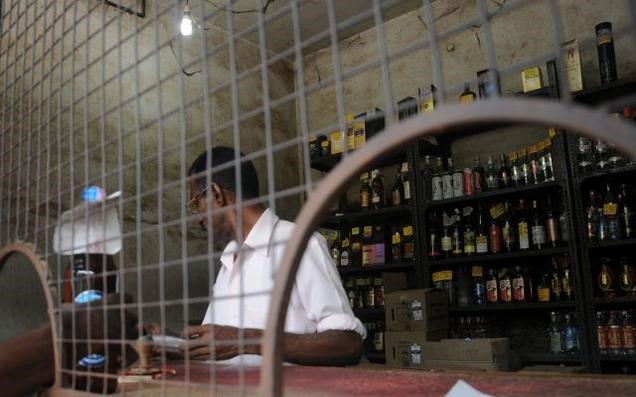
KSBC shops can equally be uninviting. The standard counter where the cheaper locally produced bottles are sold involves queuing to get to a metal screen through which orders are placed, money paid and bottles handed back. At certain times of day scores of men jostle to get their fix.

Queuing for alcohol


High security counter
 In contrast many shops have a premium room where imported bottles are sold. These tend to be less crowded due to the higher prices and are self-service so altogether far more convivial. However anyone expecting brands available in Europe will be disappointed. Wines are Indian made in other states and spirits are Indian blends.
Premium sales room

 Despite the plethora of rules and the effort required to get a drink there is still nothing better than a cold beer on a hot and humid Keralan day. Cheers!

Thursday, 17 August 2017

SNAKE BOAT RACING

Snake Boat races are held in many places in Kerala, The festival held every year on the backwaters in Alappuzha just before the Onam festival in August or September is the best known with teams competing for the prestigious Nehru Trophy.


The Snake Boats or Chundan Vallams are 110 feet long, 5 feet wide and seat up to 100 rowers in two rows along their length. The boats float low in the water and have a long curving stern. The prow is pointed and may have a decorative knob at the end. The prow rides low in the water with the length of the Snake Boat extending behind it. Apart from rowers, each boat carries a cox and leaders who maintain the rhythm of rowing through chants, songs and exclamations, all precariously perched at the stern which rises 10 feet above the water level.


Sadly we left it too late to go to see the races this year but next year ....


THE BACKWATERS

The Kerala Backwaters are the most amazing patchwork of lakes, rivers and canals between which are massive paddy fields of rice. Between the waters and the fields are wide palm tree lined banks where people carry on a simple way of life. They are a 'must visit' place for tourists who can enjoy the tranquil surroundings on a house boat - a converted rice barge covered by a wicker cladding. Alternatively you can hire a Shakira boat which is much smaller as we did before visiting the beach at Alappuzha. This is huge with what appears to be golden sands until you tread in it with wet feet at which point they turns black! Here are a few photos from our day.


Monday, 24 July 2017

A DAY IN THE LIFE OF .....

Our day usually starts around 6.00am when the sun rises and the local birds, scooters, rickshaws and dogs start to make their presence known. It is a nice cool time of day and Wi-Fi is strong so a good time to check email and catch up with Face Book over a cup of tea. If the previous day’s weather has been cloud free and hot we can enjoy a hot shower – or a cooler one if not enough sun to heat the solar water tank.

Breakfast is normally coffee and toast with either honey, marmalade or marmite. As an alternative we may have cereal or yoghurt. We have not been brave enough to try to make the typical Keralan breakfast of Idli (savoury rice cakes), Puttu (steamed rice and coconut) or Idiyappam (steamed rice noodles) each served with some form of curry.

Stella is a habitual house cleaner so goes round ensuring everything is in order (washing, beds, floors) while Bill writes up the diary or this blog. If there has been heavy rain the day before Bill has to bail out water from the upstairs balcony - due to the leaking roof.

If we are going out we try not to leave before 10.00am to miss the rush (work here starts at 10.00). Even so it is slow going in the traffic and it can take over 30 minutes to travel just a couple of miles.

If we are not going out it is often because we are waiting for something or someone to come to the house. As time has no real significance this can be at any time - or not at all.

Lunch at home may be a sandwich, cheese and biscuits or Indian snacks - samosa or battered ‘something’ such as banana, green chilli or potato. The snacks may result from a walk up the road to buy milk or bananas.

Generally the shops close to us are small, often just kiosks. Buying local is a tradition in these parts and most things required for a Keralan family can be found here. Later in the day street stalls open up for fresh vegetables and fish (mostly small ‘dabs’ or prawns).

As we have not yet got into Keralan style cooking our food shopping is done in large hypermarkets such as Lulu or Ashis. These stock grocery items that we are familiar with and fresh meat which we can freeze. It does mean arranging a car to take us but we are going to try online shopping which delivers!

On those days we go out we tend to stop at a restaurant for lunch. Menus are pretty similar so we might go for chapatti, paratha, fried rice or noodles with either a meat, prawn or vegetable ‘gravy’ or dry fried chicken or beef. The staple lunchtime meal is biryani which may be all that is on offer at some places. On occasions we have bought this as a take away to eat later. There are lots of bakers that sell dried snacks and cakes but also filled rolls and small spicy pizzas (definitely not Italian!).

Our afternoons may be spent reading or writing and, in Stella’s case, ironing! By 5.30pm the insects and mosquitoes are starting to emerge so the doors are closed (by 6.30pm it is dark anyway).

Around 7.00pm it is time for a beer which we buy by the box full at the government controlled beer and liquor outlets. Stella has tried the cheap local white wine but is not impressed and misses her glass of French or even Chilean. On the other hand a cold Kingfisher Ultra is most acceptable after a hot day.

We haven’t really got into evening meals yet. We have had biryani and made chilli con carne, chicken curry, beef patties but nothing really adventurous. Strangely neither of us has much of an appetite due to the heat. In fact some evenings we have existed on beer and crisps!

If the power stays on we read or listen to the radio or CDs in the evening. If not we sit in the dark with our torches waiting for the lights and fans to be restored – not the most comfortable way to spend time and certainly not conducive for sitting down to a big meal!

And so our day ends at about 10.30pm.